Arthur Andersen was the auditing firm in charge of independently verifying the accuracy of Enron’s financial statements and disclosures. This meant they would review statements to make sure they aligned with GAAP principles, assumptions, and concepts, among other things. In case of errors, simply edit the 1st and 2nd columns of UBTB until you get the correct balances. Enter all account transactions that have occurred during this accounting period into the 2nd column of UBTB. You can do this by either totaling the last period’s closing balances or you can enter balances as of the 1st day of this period. This makes it easier to prepare financial statements since they will contain one less step.
When to use trial balances
As with all financial reports, trial balances are always prepared with a heading. Typically, the heading consists of three lines containing the company name, name of the trial balance, and date of the reporting period. The balances of the nominal accounts (income, expense, and withdrawal accounts) have been absorbed by the capital account – Mr. Gray, Capital. Hence, you will not see any nominal account in the post-closing trial balance. However, most businesses can streamline this cycle and skip tedious steps like posting transactions to the general ledger and creating a trial balance.
Why is it important to prepare the unadjusted and adjusted trial balance?
- Each account with a balance in your accounting system, such as accounts receivable and accounts payable, appears in the trial balance with its respective balance–debits on the left and credits on the right.
- It will contain all assets, liabilities, and equity accounts so they can be used to prepare your company’s income statement and balance sheet.
- The post-closing trial balance shows the balances after the closing entries have been completed.
- However, just because the column totals are equal and in balance, we are still not guaranteed that a mistake is not present.
- If totals are not equal, it means that an error was made in the recording and/or posting process and should be investigated.
In other words, a trial balance shows a summary of how much Cash, Accounts Receivable, Supplies, and all other accounts the company has after the posting process. A trial balance is so called because it provides a test of a fundamental aspect of a set of books, but is not a full audit of them. A trial balance is often the first step in an audit procedure, because it allows auditors to make sure there are no mathematical errors in the bookkeeping system before moving on to more complex and detailed analyses.
Purpose
And finally, in the fourth entry the drawing account is closed to the capital account. At this point, the balance of the capital account would be 7,260 (13,200 credit balance, plus 1,060 credited in the third closing entry, and minus 7,000 debited in the fourth entry). A company’s transactions are recorded in a general ledger and later summed to be included in a trial balance. If a trial balance is in balance, does this mean that all of the numbers are correct? It is important to go through each step very carefully and recheck your work often to avoid mistakes early on in the process. Both unadjusted and adjusted trial balances have an important role to play when it comes to being the source of transactions companies undertake.
Our mission is to improve educational access and learning for everyone.
Since temporary accounts are already closed at this point, the post-closing trial balance will not include income, expense, and withdrawal accounts. It will only include balance sheet accounts, a.k.a. real or permanent accounts. Before that, it had a credit balance of 9,850 10 successful cofounders and why their partnerships worked as seen in the adjusted trial balance above. Nominal accounts are those that are found in the income statement, and withdrawals. A trial balance plays a major role in the accounting cycle, notably at the end of an accounting period before generating financial statements.
Trial Balance: Definition, How It Works, Purpose, and Requirements
However, if totals are equal, it still does not fully guarantee that no errors were made; for example, when a transaction was recorded twice or when it was not recorded at all. Most accounting software will let you generate a trial balance at any point in time to allow you to assess the current state of your accounts. Since most companies have computerized accounting systems, they rarely manually create a TB or have to check for out-of-balance errors. Another way to find an error is to take the difference between the two totals and divide by nine.
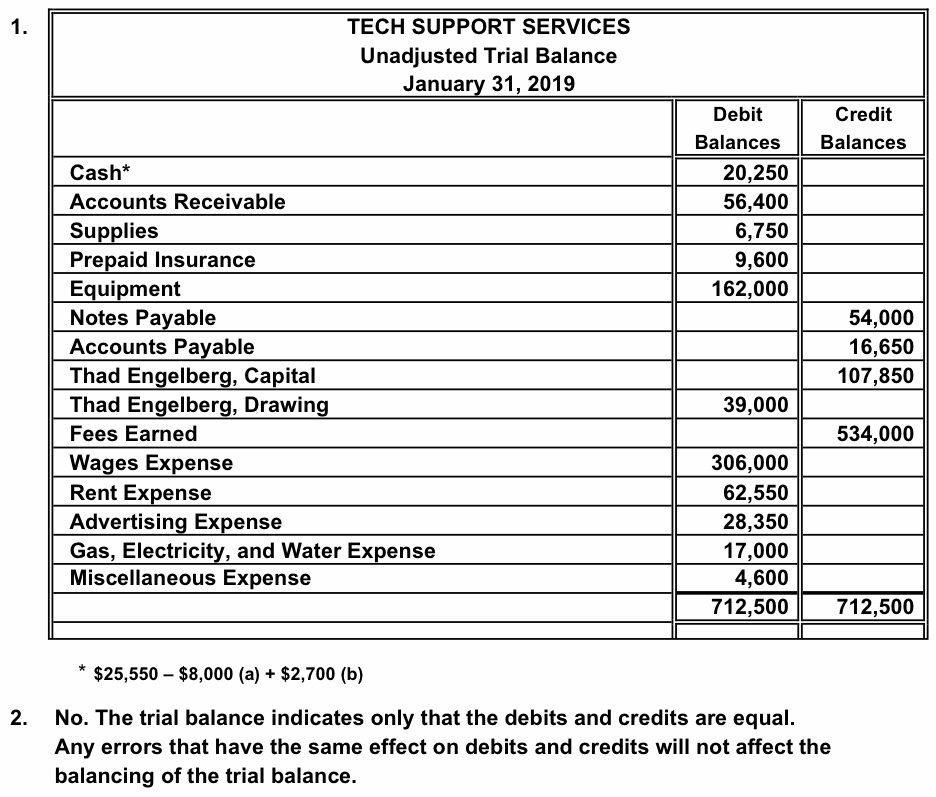
An unadjusted trial balance is a listing of all the company’s accounts and their balances at a specific point in time, usually at the end of an accounting period before any adjusting entries have been made. Bookkeepers, accountants, and small business owners use trial balances to check their accounting for errors. The unadjusted trial balance is the initial report you use to check for errors, and the adjusted trial balance includes adjustments for errors. Usually the debit and credit balances of each account are listed to the right of the account name. Also, a full heading and account numbers usually appear on the unadjusted trial balance. The beginning trial balance or unadjusted trial balance simply lists the unadjusted balances for each account.
He then took all the balances of each account in the Ledger and summarized them in an unadjusted trial balance which is as follows. The following unadjusted trial balance has been prepared from the ledger accounts of Company A. When the total debits and total credits are not equal, it is a clear indication that a mistake has been committed in the journalizing and/or posting process. There are no special conventions about how trial balances should be prepared, and they may be completed as often as a company needs them.
A trial balance is often used as a tool to keep track of a company’s finances throughout the year, whereas a balance sheet is a legal statement of the financial position of a company at the end of a financial year. Whereas, the adjusted trial balance (ATB) is the same as UTB except that it also includes any adjusting entries made during an accounting period. In the first and second closing entries, the balances of Service Revenue and the various expense accounts were actually transferred to Income Summary, which is a temporary account. The Income Summary account would have a credit balance of 1,060 (9,850 credit in the first entry and 8,790 debit in the second). You record all your accounting transactions and post them to the general ledger, then assess the debit and credit totals. It’s one of the first lines of defense against accounting errors and a pivotal report within double-entry bookkeeping.