
Whether you credit or debit your income summary account will depend on whether your revenue is more than your expenses. Accounting software automatically handles closing entries for you. If you don’t have accounting software, you must manually create closing entries each accounting period. Closing entries are necessary to reset the balances of temporary accounts to zero and to update the Retained Earnings account.
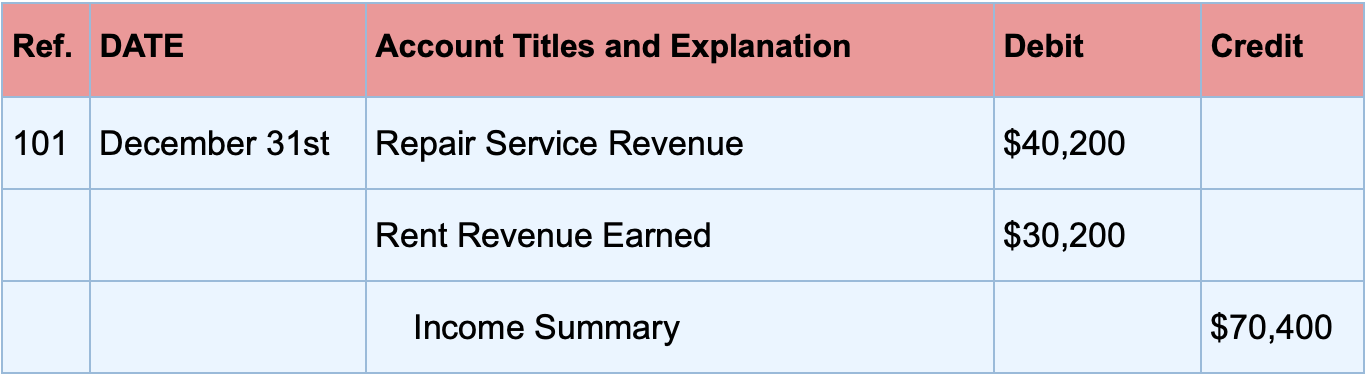
Step 1: Close all income accounts to Income Summary
Chartered accountant Michael Brown is the founder and CEO of Double Entry Bookkeeping. He has worked as an accountant and consultant for more than 25 years and has built financial models for all types of industries. He has been the CFO or controller of both small and medium sized companies and has run small businesses of his own. He has been a manager and an auditor with Deloitte, a big 4 accountancy firm, and holds a degree from Loughborough University.
Step 1 of 3
Closing all temporary accounts to the retained earnings account is faster than using the income summary account method because it saves a step. There is no need to close temporary accounts to another temporary account (income summary account) in order to then close how to calculate straight line depreciation that again. If your revenues are greater than your expenses, you will debit your income summary account and credit your retained earnings account. Notice that the balances in the expense accounts are now zeroand are ready to accumulate expenses in the next period.
Analyzing the opening trial balance:
For corporations, Income Summary is closed entirely to “Retained Earnings”. The Income Summary balance is ultimately closed to the capital account. Closing entries help in the reconciliation of accounts which facilitates in controlling the overall financials of a firm. The third entry requires Income Summary to close to the RetainedEarnings account. To get a zero balance in the Income Summaryaccount, there are guidelines to consider. All accounts can be classified as either permanent (real) ortemporary (nominal) (Figure5.3).
- Now that the income summary account is closed, you can close your dividend account directly with your retained earnings account.
- If the subsidiaries also use their own subledgers, then their subledgers must be closed out before the results of the subsidiaries can be transferred to the books of the parent company.
- The main purpose of these closing entries is to bring the temporary journal account balances to zero for the next accounting period, which keeps the accounts reconciled.
- Temporary accounts include revenue, expenses, and dividends.
- If your revenues are greater than your expenses, you will debit your income summary account and credit your retained earnings account.
To make them zero we want to decrease the balance or do the opposite. We will debit the revenue accounts and credit the Income Summary account. The credit to income summary should equal the total revenue from the income statement. Permanent accounts, such as asset, liability, and equity accounts, remain unaffected by closing entries.
The assumption is that all income from the company in one year is held for future use. Any funds that aren’t held incur an expense that reduces NI. One such expense that’s determined at the end of the year is dividends. The last closing entry reduces the amount retained by the amount paid out to investors.
However, if the company also wanted to keep year-to-dateinformation from month to month, a separate set of records could bekept as the company progresses through the remaining months in theyear. For our purposes, assume that we are closing the books at theend of each month unless otherwise noted. Answer the following questions on closing entries and rate your confidence to check your answer. We have completed the first two columns and now we have the final column which represents the closing (or archive) process.
You should recall from your previous materialthat retained earnings are the earnings retained by the companyover time—not cash flow but earnings. Now that we have closed thetemporary accounts, let’s review what the post-closing ledger(T-accounts) looks like for Printing Plus. Closing entries are posted in the general ledger by transferring all revenue and expense account balances to the income summary account. Then, transfer the balance of the income summary account to the retained earnings account. Finally, transfer any dividends to the retained earnings account.
If expenses were greater than revenue, we would have net loss. A net loss would decrease owner’s capital, so we would do the opposite in this journal entry by debiting the capital account and crediting Income Summary. Take note that closing entries are prepared only for temporary accounts. Finally, you are ready to close the income summary account and transfer the funds to the retained earnings account. No, permanent accounts carry their balances forward to the next accounting period.
Our discussion here begins with journalizing and posting theclosing entries (Figure5.2). These posted entries will then translate into apost-closing trial balance, which is a trialbalance that is prepared after all of the closing entries have beenrecorded. Once we have made the adjusting entries for the entire accounting year, we have obtained the adjusted trial balance, which reflects an accurate and fair view of the bakery’s financial position. After the closing journal entry, the balance on the drawings account is zero, and the capital account has been reduced by 1,300. All of Paul’s revenue or income accounts are debited and credited to the income summary account. This resets the income accounts to zero and prepares them for the next year.

دیدگاهتان را بنویسید